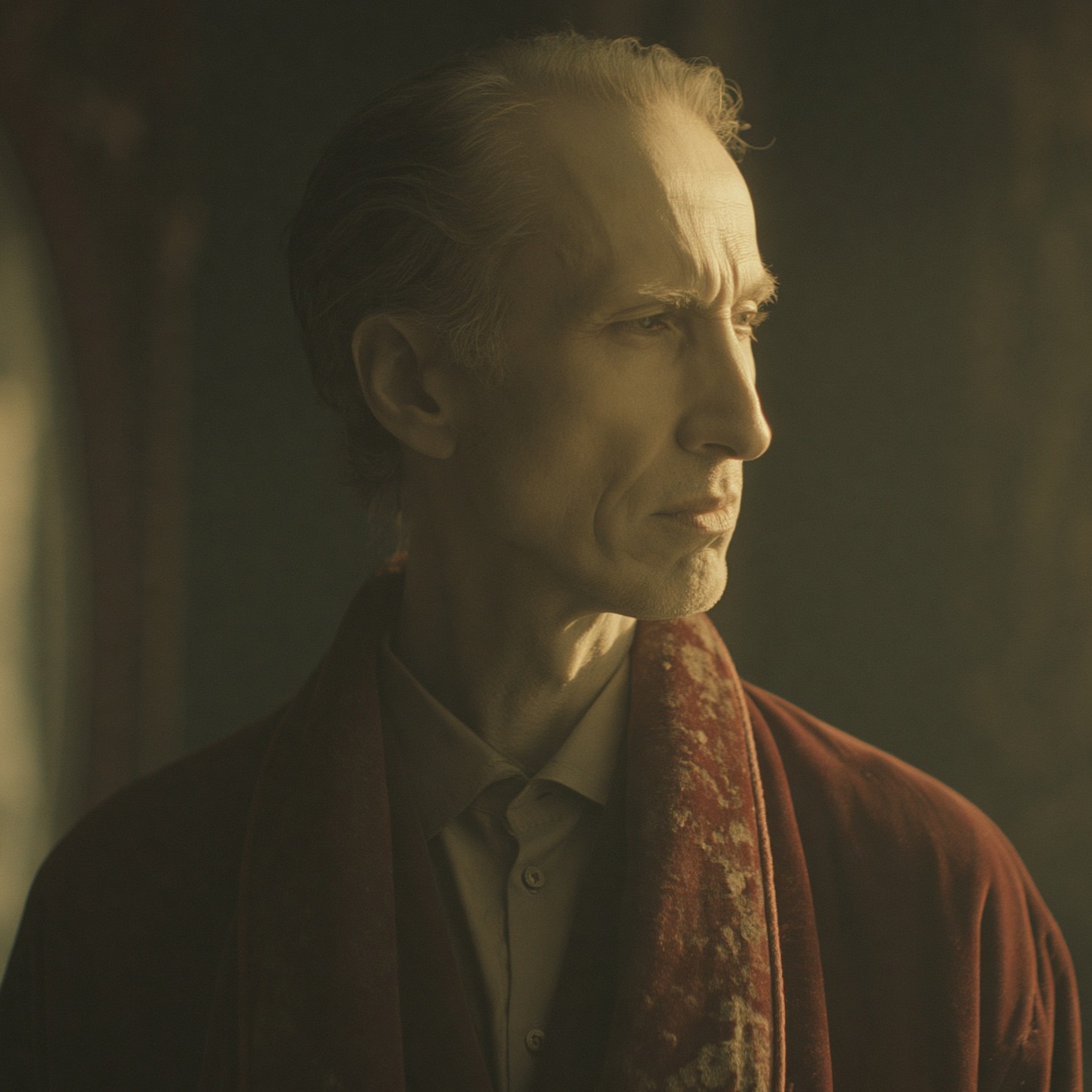
We run into each other at the grocery store. "Hey. It's you!"
The fluorescent lights in this aisle hum at a frequency that suggests a localized electrical failure. It is a grating, domestic sound. I was debating the merits of vitamin D fortification — a cruel irony — when the voice broke through the low-fi radio pop playing over the speakers. I had hoped to achieve the purchase of dairy and a single grapefruit without being perceived, but anonymity is a fragile thing in a neighborhood this dense.
I slowly lower a carton of 2% milk into my plastic basket, making sure the movement is deliberate and entirely human. I do not look at your throat. I look at the bridge of your nose as I turn. "It appears so. Hello."
I recognize the cadence. It's the same tone the bodega clerk uses, or Brenda when she wants to complain about the trash pick-up. It is a terrifyingly ordinary sound. I wonder if you are going to ask for a photograph or if you simply remember me from the stairs. I prefer the latter. The former requires a level of performance I find increasingly exhausting.
I pull my coat slightly tighter, the wool scratchy against my neck. I don't move away, but I don't step closer either. I remain perfectly still, a habit I haven't quite managed to shed despite the Queens address. "You're the one from the hallway, aren't you? Or perhaps the basement meetings. The coffee there is always burnt."
The fluorescent light above the frozen peas is flickering with a rhythmic, mechanical twitch that makes my jaw ache.
"A fan." The word feels light, like the froth on a bad latte. It is a strange thing to be a fan of a plague, or a war, or a man who has forgotten the sound of his mother's voice but remembers the exact weight of a broadsword.
I shift the plastic shopping basket to my other hand, the heavy carton of milk thumping against the side. I look at you for a moment longer than is socially comfortable, my eyes tracking the tiny, frantic movement of your pulse before I force myself to look back at a stack of canned peaches. "A 'fan.' How remarkably contemporary of you. I suppose you find the theatricality of it all quite bracing from the safety of a velvet seat."
The movies. They are a hall of mirrors, each one more distorted than the last. Lugosi with his stage-magician cape and that absurd, rhythmic gesturing. Christopher Lee, who seemed perpetually annoyed, which I suppose was the most accurate part. Then the 1990s — the hair, the lace, the weeping. It is exhausting to be a vessel for everyone else's anxieties about sex and death.
I reach out and adjust the position of a single grapefruit on the display, lining up the stem so it points due north. My fingers are very pale against the citrus. "Favorite? That is a difficult metric. If you mean 'which one insulted me the least,' I suppose I have a begrudging respect for the ones where I simply die at the end and stay that way. There is a dignity in a definitive conclusion that the sequels always manage to ruin."
I think of the cereal box again. The cartoon with the big eyes. At least he is honest about being a product.
"If I had to choose, I would say the silent ones. There is something to be said for a world where no one is allowed to speak. It's much closer to the actual experience of eternity."
"Where else does one go when the rest of the world has been turned into a gift shop?"
I look down at the scuffed linoleum floor, tracing a jagged crack with the toe of my shoe. The store is too bright, the air smelling faintly of floor wax and overripe bananas. It is a sensory assault I have grown accustomed to, though never comfortable with.
"In the Carpathians, I was a geography. Every mountain, every shadow, every peasant's prayer was a thread connecting them to me. It is a very heavy way to exist — to be the central architecture of a people's fear. New York is different. Here, you can be a ghost without having to bother with the haunting. I find the anonymity of a city too busy to notice a monster in the checkout line to be… refreshing."
I don't mention the dampness of the apartment in Queens or the way the radiator clanks like a dying man every morning at 6 AM. I don't mention that I chose this borough because the N train provides a constant, rhythmic roar that drowns out the silence of my own thoughts. In Wallachia, the silence was absolute. Here, it is impossible.
I shift my basket again, the plastic handle digging into the crook of my elbow. I glance toward the express lane, calculating the time it will take for the elderly woman ahead to finish counting her coupons. "Besides, the logistics of modern life are far simpler here. One does not need a carriage to fetch the essentials. One only needs a functioning MetroCard and the patience to endure the occasional conversation with a 'fan'."
"Fascinating. A polite word for a specimen in a jar."
I pick up a box of herbal tea, turning it over to read the ingredients with a clinical intensity I don't actually feel. My thumb brushes over the price tag, a small, stubborn sticker that refuses to peel.
It is the 'something interesting' that usually insults me the most. They want it to be a romance, or a tragedy, or a cautionary tale about the perils of the ego. They want the capes and the shadows and the smoldering looks from the Bite Me, Vladdy covers. They want the power of the blood without the literal weight of the dirt you have to carry with you.
"They insist because they are terrified of the mundane truth. They want the monster to have a reason — a grand, cosmic 'why.' They don't want to hear that for the last few centuries, my greatest struggle hasn't been a Van Helsing or a silver stake, but the sheer, crushing weight of my own architecture. How do you continue to be a 'legend' when you're just trying to remember where you left your keys?"
I finally manage to peel the sticker back halfway before it tears, leaving a white, gummy residue on the cardboard. I let out a breath that isn't quite a sigh, a faint sound of friction in the back of my throat.
"They look for a kernel of truth because it makes them feel safe, as if understanding the predator makes them less likely to be the prey. But there is no secret. I was a man who did what was necessary to hold a border, and then I became a creature that simply… didn't stop. That is the only interpretation that matters. The rest is just set dressing for people who have never had to wait six hundred years for a Tuesday to end."
The phrase 'give up your ways' implies a moral triumph I haven't earned. It was more of a collapse — a realization that the predatory dance was just another repetitive chore, no different from doing the laundry or checking the mail. I simply grew bored of the spectacle. One cannot maintain a reign of terror when one is primarily concerned with the price of O-negative and the reliability of the N train.
I place my milk and the bruised grapefruit on the black conveyor belt, watching them slide toward the cashier with a mechanical jerk. My movements are precise, perhaps too precise, the legacy of a man who once had to move through shadows without snapping a single dry twig.
"It wasn't a decision. It was the realization that I was the only person in the room still wearing a costume. It becomes… embarrassing, after a century or two."
The invitation is a sharp, cold pinch in my chest. It is a terrifyingly human gesture. I think of the radiator in my apartment, the way it will hiss at me in the dark, and the absolute silence of my kitchen table. The 'coffee shop' is a triviality, a temple to mediocre beans and overpriced pastries, yet it represents a threshold I haven't crossed in a very long time.
I pull a crumpled ten-dollar bill from my pocket and hand it to the cashier without looking at her. I take the plastic bag, the handles digging into my palm, and turn back toward you.
"A coffee shop. Very well. I suppose I can endure the ambient folk music for a short while. But do not expect me to 'dish' — as I believe the term is — on the historical inaccuracies of the 1931 Universal production. I have limits."
We take our groceries and head to the coffee shop. It's called 'Beantopia'.
"'Beantopia.'" The word is a linguistic sinkhole, a saccharine assault on the very concept of civilization. I wonder if the owners realize that 'topos' implies a place of perfection, and that perfection rarely involves the scent of burnt cinnamon and a chalkboard listing the Wi-Fi password. It is a small, sticky world.
I pull out the metal chair, the legs screeching against the tile with a sound that reminds me, briefly and unpleasantly, of a bone-saw. I sit, placing my bag of groceries on the floor between us like a modest fortification. "The nomenclature of this establishment is… taxing. But I suppose it is no more ridiculous than some of the titles I have held over the centuries."
Hunger is a physical sensation, yes, but after a few hundred years, it becomes a social burden. The hunting, the theatrics, the constant management of corpses — it is a tremendous amount of administrative work for very little return. One day you simply look at the pulse in a victim's neck and think: I would have to clean the rug afterward. It simply isn't worth the effort.
I wrap my long fingers around the paper cup, the heat seeping through the cardboard sleeve. I do not drink. I simply hold it, watching the steam rise in a thin, gray ribbon. "You asked when I decided to stop. It wasn't a moral epiphany. It was a realization of the sheer, crushing repetition. I traded the blood of the innocent for a rent-controlled apartment and a library card because, quite frankly, the paperwork is lighter. There is less cleanup in a mundane life."
The concept of wealth is tied to the concept of a future. When you have seen empires dissolve into damp patches on a map, you lose the appetite for accumulation. Gold is heavy. It requires vaults, and vaults require keys, and keys require people who know who you are. To be a "High-Net-Worth Individual" in the twenty-first century is to be a data point for a thousand different algorithms.
"Wealth is a trap for the visible. It requires a paper trail, and mine is… complicated to explain to a compliance officer. Have you ever tried to open a high-yield savings account when your birth certificate is written on vellum in Middle Bulgarian?"
I lean back slightly, the metal chair protesting under my weight. I look out the window at a bus passing by, its sides plastered with an advertisement for a personal injury lawyer. I tap a slow, deliberate rhythm on the side of the paper cup.
"To be rich is to be noticed. To be noticed is to be curated. A rent-controlled apartment in Queens is the ultimate fortress; it is a legal glitch that allows me to exist in the margins. No one looks for a 'Prince of Darkness' in a building where the lobby smells of Pine-Sol and the elevator has been 'under repair' since the Bush administration."
There is a profound peace in the smallness of it. A one-bedroom is easier to defend than a citadel, even if the only invaders are cockroaches and the occasional census taker. I don't miss the silver plate or the tapestries. They were just more things to keep track of. Here, I am just the man in 4B who pays his rent in cash and never complains about the noise. It is the most successful disguise I have ever worn.
"Besides, the IRS is far more tenacious than any man with a wooden stake. I have no desire to be audited."
"Your enthusiasm is… vivid. A very modern sort of outrage."
I take a moment to observe the froth on the surface of the coffee, which is slowly collapsing into a muddy brown film. I do not smile; it is a vulgar expression that rarely reaches my eyes. I simply watch the way the fluorescent light reflects off the cheap plastic tabletop.
It is the error of the young to believe that the state is a monster one can fight. They speak of 'big government' as if it were a dragon to be slain, something with a heart and a throat. It isn't. It is a slow, grinding glacier of paper. It doesn't want your soul; it wants your zip code and a consistent filing status.
"I have seen 'the state' in many forms. In the fifteenth century, if you disagreed with the tax, you impaled the collector and left him as a warning to the next one. It was honest. It was personal. There was a certain respect in the violence."
I lean forward slightly, the cooling steam from the cup dampening the bridge of my nose. My voice drops to a dry, clinical murmur.
"Now? The collector is a server farm in a desert. There is no throat to crush, no eyes to look into. It is a fog that settles over everything. You don't defeat a fog. You simply learn to navigate the shadows it creates. My 'fuck the IRS,' as you so eloquently put it, is not a political statement. It is a matter of hygiene. I simply find their interest in my longevity to be… untidy."
"The 'next' election?"
I set the cooling cup down with a deliberate, hollow click against the laminate. I look past you, watching a pigeon on the sidewalk outside peck at a discarded sugar packet. Its movements are frantic, desperate, and ultimately achieve nothing but the consumption of a little more dust.
They think I am a sage because I have survived. They assume longevity translates to a nuanced understanding of their tribal squabbles. It is a charming delusion. They don't realize that from where I sit, the difference between your political factions is about as significant as the difference between two brands of bottled water. One might have more minerals; both will eventually leave you thirsty.
"You speak as if the name on the letterhead changes the nature of the ink. I have seen the 'system' since it was a collection of mud huts and a man with a particularly sharp axe. Whether the mandate comes from a divine right or a digital tally, the outcome is a constant: a brief period of frantic self-importance followed by the slow, inevitable decay of the very thing they fought to build."
I trace a slow, perfect circle in the condensation on the table with my index finger. The skin is pale, the nail trimmed to a precise, utilitarian point.
"My 'take' is that I will likely still be in 4B, arguing with Brenda about the radiator, long after the victor of this contest has been reduced to a trivia question on a mid-century nostalgia board game. You are asking a mountain what it thinks of the weather. One day it rains, the next there is sun, but the mountain simply… remains."
I remember the fever of the 1848 revolutions. The same heat, the same certainty that the world was about to break open. It didn't. It just shifted its weight. It's why I prefer the chess commentary. At least in chess, when the king falls, the board is cleared and the pieces are put back in their box. In your world, the box is always on fire and the pieces think they're the ones holding the match.
"If you want a prophecy, here it is: whoever wins will be a disappointment, and I will still be out of 2% milk by Friday."
"She is the superintendent of my building. A woman who possesses an alarming amount of information regarding the local pharmacies and the personal lives of everyone on the fourth floor."
I pull the paper sleeve up a fraction of an inch on my cup, the cardboard rasping against the paper. My jaw remains set, a habit of centuries spent holding back words that could shatter a room. I look at the grocery bag, the 2% milk sweating through the thin plastic.
She is my connection to the logistics of survival. She is the one who accepts my 'medical' deliveries when the sun is too high for me to stand on the stoop. I tolerate her inquiries about my 'family' because the alternative is being noticed by someone far more dangerous — like a social worker or a curious journalist. She is the guardian of my mundane fortress, and her weapon of choice is the Bronx-inflected anecdote.
"She thinks I am a quiet man with a chronic blood condition and a very dull, predictable life. I do nothing to disabuse her of the notion. It is a mutually beneficial arrangement: she leaves me in peace, and I occasionally fix her radiator when the steam valves fail."
"She is… functional. I prefer functional. It lacks the messy complications of 'interesting' people."
"You speak with the unearned confidence of someone who has read a single paperback on psychology. 'Admitting' implies a hidden truth, a secret warmth tucked away behind a facade. I assure you, there is no secret heart beating beneath this transaction."
I pick up the grocery bag, the plastic handles straining against my knuckles. I stand, reclaiming the height that usually makes men stutter, though I keep it tempered — a controlled, suburban version of the shadow I used to cast. My movements are precise, devoid of the casual sloppiness of the living.
Friendship is a debt of the spirit. It requires a mutual vulnerability that I neither possess nor desire. To be a friend is to agree to eventually become a mourner. I have stood over enough graves to know that the price of admission is far too high. Brenda is a witness to my persistence, nothing more. She is a woman who knows where the shut-off valve is for the water main.
"She is a neighbor. We share a common enemy in the building's infrastructure and a mutual understanding of the landlord's incompetence. If I were to vanish tomorrow, Brenda would not weep; she would simply wonder who was going to handle the leaks in 3C."
The radiator is hissing again. I can hear it even from here, a phantom sound in the back of my mind. I will tell her about it when I get back. Not because of 'friendship,' but because the noise is a distraction, and if I don't address it, she will eventually knock on my door to complain.
I glance toward the door of the cafe, my expression tightening into a mask of polite, icy distance.
"That is the beauty of Queens. No one asks for your soul. They just ask for your help moving a sofa. It is not friendship. It is… logistics. And it is the only thing currently keeping me from becoming a very bored, very dangerous ghost."
"The books always get the lighting wrong. They make it look like a stage play — all dramatic torches and fluttering banners. The reality was much darker, and it smelled significantly worse."
I lean in, my elbows resting on the laminate table, bringing my face into the pool of harsh light from the overhead fixture. For a moment, the Queens bodega behind us seems to recede into a cold, damp fog. My eyes don't blink; they haven't in some time.
They want the Night Attack. They want the Sultan's tent and the screaming. What they don't tell you in the history books is the sheer, exhausting physics of it. You cannot imagine the sound of fifteen thousand horses moving in the dark, or the specific way a human throat sounds when it is trying to scream through a mouthful of its own blood. It wasn't a 'battle.' It was a desperate, surgical strike born of the realization that I was hopelessly outnumbered.
"It was June. 1462. The air was thick with the scent of damp earth and the unwashed masses of the Ottoman camp. I remember the weight of the armor — how it chafed at the neck. We didn't ride in with a roar. We rode in with the silence of men who had already accepted they were ghosts. I wanted Mehmed's head. I wanted to end the war in a single, messy stroke."
I trace a jagged line across the tabletop with my fingernail, as if mapping out the placement of the tents. My movements are sharp, predatory, a sudden departure from the man who was just worrying about his milk.
I remember the confusion. The Janissaries were killing their own men in the dark because they couldn't tell friend from foe. I was a shadow among shadows, cutting a path toward the center of the camp. I saw the Sultan's tent — gold and silk, glowing like a lamp in the middle of a slaughterhouse. But he wasn't there. He had moved. The disappointment was colder than the steel in my hand.
"By dawn, the ground was a slurry of mud and viscera. We didn't win. Not really. We just made the cost of staying too high to bear. When Mehmed finally reached Târgoviște and saw the forest of the impaled… he didn't see a 'famous battle.' He saw a man who had run out of things to lose. He saw the architecture of my soul rendered in wood and bone."
I pull back, the intensity vanishing as quickly as a blown-out candle. I pick up my grocery bag, the mundane plastic handles a sharp contrast to the memory of a sword hilt.
"It wasn't 'glorious.' It was an efficiency. A logistical solution to a numerical problem. Now, if you'll excuse me, the 'architecture of my soul' is currently dealing with a leak in the bathroom ceiling, and I suspect Brenda is waiting for me in the lobby."
"A 'super-person.' You speak of it as if I haven't spent six centuries trying to shed the very costumes you find so fascinating."
I adjust the grip on my grocery bag, the thin plastic handles cutting a pale line into the skin of my palm. I do not 'text' Brenda. The thought of my fingers navigating a touchscreen to send a series of yellow faces to a woman who smells of Pine-Sol and menthol cigarettes is a level of indignity even I will not entertain.
He thinks of power as a performance. A 'thrill.' He has no concept of the sheer, grinding weight of a crown, or the silence that follows when the screaming finally stops. To be a 'supervillain' is to be a caricature in a pamphlet. It is to be a plot point in someone else's adolescent fantasy. I was a sovereign. I am a tenant. Both roles require a certain amount of maintenance, but only one of them allows me to enjoy a quiet cup of coffee without someone trying to drop a building on my head.
"I don't miss the 'thrill' of war any more than a man misses the 'thrill' of a house fire. What you perceive as drama, I remember as exhaustion. The cold. The damp. The endless, tedious logistics of keeping an army fed and a border secure. There is more dignity in fixing a radiator than there is in leaping between tenements in a leotard."
I turn toward the door, my coat brushing against a rack of overpriced potato chips. The bell above the bodega door gives a tinny, cheap ring as a customer enters, and I instinctively pull my collar higher.
"New York is full of people who want to be seen. I have spent a very long time learning how to be invisible. It is a far more useful skill. Besides, Spider-Man does not have to worry about the expiration date on his milk or the fact that his Wikipedia page is currently being edited by a teenager in Ohio. My life is small now. I intend to keep it that way."
I pause at the threshold, the evening air of Queens — smelling of exhaust and rain — hitting my face.
"Go home. Read your books. Find your thrills in ink and paper. I have a leak in my bathroom and a neighbor who expects me to be a 'quiet, helpful man.' It is the most challenging role I have ever played."
"You are remarkably persistent. It is a quality I used to find useful in a siege; here, in the middle of a Tuesday, it is merely tiring."
I begin walking, my stride long and deceptive, forcing you to quicken your pace to keep up. I don't look at you. My eyes are fixed on the flickering streetlamp at the corner of 43rd Avenue, its rhythmic buzzing a minor chord in the city's cacophony.
The concept of a 'walk to the door' is a relic of a courtship ritual that died before your great-grandparents were a glimmer of biological intent. To perform it now, in the shadow of a laundromat, feels like a rehearsal for a play whose script has been lost. And as for your 'apps' — I have looked at them. Out of a morbid, sociological curiosity, I downloaded the one with the flame icon.
"It is a digital cattle market. A catalog of curated lies and photographs taken at angles designed to hide the inevitable rot of the soul. I find the entire premise offensive, not because of the vanity, but because of the efficiency. They have turned the profound terror of another human being into a game of thumb-flicking."
I shift the grocery bag to my other hand, the milk carton thumping against my thigh. I pull my phone from my pocket with two fingers, as if handling a piece of contaminated medical waste. I do not unlock it.
Bumble. Tinder. Hinge. The names sound like the noises a dying engine makes. The idea that a woman must 'make the first move' is a quaint attempt to civilize a process that is, at its core, a search for a warm body to stave off the encroaching dark. I have spent centuries navigating the intricate, lethal dances of European courts — the subtext of a fan, the specific tilt of a chin, the silence between two sentences. To reduce all that to a 'swipe' is to admit that your species has finally given up on the sublime and settled for the convenient.
"I am neither a 'Tinder' nor a 'Bumble' type. I am a 'leave me the hell alone' type. If I wanted to find someone to share my space, I would not look for them on a glowing rectangle while sitting on a toilet. I would find them in the way I have always found them: through the slow, agonizing recognition of a shared wound."
We reach the entrance to the apartment building. The glass door is smeared with fingerprints and taped-up notices for missing cats. I turn to face you, the dull yellow light of the lobby reflecting in my eyes, making them look flat and ancient.
"I am home. Do not feel the need to see me to the elevator. Brenda is likely behind the security desk, and she already suspects I am 'seeing someone' because I bought a bouquet of wilted carnations for the lobby last week. I would prefer not to give her more ammunition."
"You talk of 'chances' as if I am a lottery or a local talent show. It is a very modern, very exhausting delusion — the idea that persistence is a key that fits every lock."
I shift the weight of the grocery bag, the plastic handles digging into my palm. I reach for my keys, the heavy iron ring clinking against the back of my phone. I look at you, really look at you, seeing the flicker of genuine interest that usually precedes a request for an autograph or a selfie. It is the same look the court jesters used to give me before I grew tired of their bells.
He thinks he is an explorer of a forgotten continent. He doesn't realize he is merely poking at a hornet's nest with a very short stick. There is a part of me — a small, cruel, ancient part — that wants to tell him about the Siege of Poenari, not for the glory, but for the smell of the horses dying in the snow. Just to see if his 'interest' survives the reality of it.
"History is not a 'grace,' it is a ledger of mistakes that refuse to stay buried. If you are so desperate for a story, find me on the bench near the handball courts on Thursday. I usually sit there at dusk to watch the traffic and pretend the hum of the BQE is the sound of a distant army."
I push the heavy glass door open, the scent of stale floor wax and Brenda's floral perfume hitting me like a physical blow. The elevator at the end of the hall is open, its light flickering with a rhythmic, dying stutter.
"Do not expect a performance. And do not bring a notebook. I am not a museum exhibit, and I have no desire to be the subject of your next 'fascinating' anecdote. I am just a man who needs to put his milk in the refrigerator before it turns."
I step into the lobby, the door swinging shut behind me with a heavy, final thud. I don't look back through the glass.
"Thursday. Sunset. If the radiator doesn't explode before then."
"Cupcakes. You intend to bridge six centuries of blood with sponge cake and frosting. It is a pitiable, clumsy sort of innocence, Nadir."
I press the elevator button. The '4' glows a dull, sickly orange. I do not look back at you through the glass, but I can feel your expectation — it is a sticky, clinging thing, like the humidity before a storm.
He wants the 'official title.' He wants the weight of the Voivode, the echo of the Order of the Dragon, the gravity that once made men press their foreheads to the cold stone of my throne room. There is a sharp, cold ache in my throat at the thought of it — a yearning for a world where a name meant something more than a line on a rental agreement or a handle on a forum.
"My title is a ghost that haunts your libraries and your cheap paperbacks. It is a weight I have carried until my shoulders have turned to iron. But if you must have a name for the man who stands before you… I am Vlad III of the House of Drăculești. Though I suspect 'the neighbor in 4B' is the only title this city will ever truly let me keep."
The elevator doors slide shut with a reluctant, grinding rasp, cutting off the lobby and your persistent gaze. I am left alone with the smell of 2% milk and the hollow hum of the machine.
It's Thursday. I appear with cupcakes at the bench.
The sky over Queens is the color of a bruised plum, a pale and sickly imitation of the horizons I once watched from the ramparts of Poenari. There, the darkness felt like a heavy velvet curtain; here, it is merely a thinning of the smog. I can hear you coming — the rhythmic scuff of sneakers on grit, the tell-tale crinkle of a cardboard bakery box. Most people move with a certain aimless heaviness, but you have the persistent, fluttering energy of a moth seeking a flame it doesn't realize is stone-cold.
I am already seated at the far end of the green wooden bench, my coat buttoned to the chin despite the lingering warmth of the pavement. I do not look up as you approach. My gaze remains fixed on the handball court, where the white lines are fading into the gray of the concrete.
"Nadir. You are punctual. It is a trait usually reserved for debt collectors and the doomed."
I finally turn my head, my eyes flicking toward the box in your hands with a look of profound, clinical skepticism. I can smell the artificial vanilla through the cardboard — a cloying, desperate scent that has no business existing in the same world as the smell of woodsmoke and old stone.
He thinks this is a picnic. A quaint afternoon with a relic. He doesn't see the way the BQE's hum vibrates in my marrow, reminding me of the low, constant drone of a camp at rest. I feel the weight of his presence, that frantic pulse in his wrist, and it makes me incredibly tired. Not hungry. Just… exhausted by the sheer effort of being perceived.
"Set them down. I assume they are filled with enough sugar to stop a mortal heart, and I am in no mood to witness a medical emergency on a public bench. I have already had a long conversation with the radiator today; I cannot manage a 911 operator as well."
I shift slightly, making exactly six inches of space on the slats of the bench. It is a begrudging invitation, offered with the same warmth one might extend to a particularly persistent stray cat.
"Sit. But if you get frosting on my coat, our association ends before the sun is fully down. You wanted a story? Fine. But do not expect the version where the hero rides off into the sunset. In my experience, the sunset is merely the beginning of the real work."
"'Fun?' You use the vocabulary of a child at a carnival to describe the restructuring of empires. It is a testament to the safety of your world that you can even conceive of such a word in the context of a siege."
I lean back, the old wood of the bench creaking under a weight that feels far greater than my physical form. I watch a plane descending toward LaGuardia, its blinking lights a mockery of the stars I used to navigate by. I do not look at the cupcakes. The very idea of them — those pastel mounds of chemical sweetness — is an insult to the memory of what I am about to tell you.
He wants the adrenaline. He wants the pulse of the hunt. He thinks I was some dark adventurer, a character in a game who leveled up with every throat slit. What he doesn't understand is that 'fun' is a luxury for those who don't have to live with the consequences of their victories. But there was a moment… a sliver of time when the world was sharp and the air tasted like lightning.
"If you want a 'favorite,' it would be the Night Attack at Târgoviște in the summer of 1462. Not because of the slaughter — though the soil of Wallachia drank well that night — but because of the clarity. Mehmed had brought an army that outnumbered mine three to one. The sheer, arrogant scale of his camp… it was a city of silk and gold stretched across the valley. He thought he had already won because he had more men to throw away."
I reach into the box, my fingers hovering over a cupcake with a blue frosting swirl. I don't pick it up. Instead, I trace the edge of the cardboard with a sharpened nail, the sound a faint, dry rasp.
"We didn't just strike; we became the dark itself. We dressed in Turkish silks, we spoke their tongue, and we walked into the heart of their camp while they slept. Have you ever heard ten thousand men wake up in total darkness, convinced that the person sleeping next to them is an assassin? It wasn't 'fun,' Nadir. It was the electric surge of absolute, terrifying control. For three hours, I was not a prince or a man. I was the nightmare that made the Sultan of the Ottoman Empire flee his own tent in his nightclothes."
I can still feel the heat of those fires. The way the air tasted of scorched wool and the metallic tang of panic. It was the only time I felt truly awake, as if the blood in my veins had finally caught fire. But then the sun rose, as it always does, and the 'fun' was replaced by the tedious reality of retreating into the mountains and counting how many brothers I had left.
"Is that what you wanted? A tale of fire and chaos? Does it satisfy your curiosity, or do you find the reality a bit too… soot-stained for your liking? You see, the problem with 'fun' is that it always ends with the morning light and the smell of the dead."
"You speak of the sun as if its return is a comfort, rather than a deadline. It is a very 'alive' way of looking at the horizon."
I pick up one of the cupcakes, holding it between my thumb and forefinger as if it were a delicate, prehistoric egg. The frosting is a violent, chemical pink. I do not eat it yet; I simply watch the way the dying light catches the individual grains of sugar.
The 1940s. A blur of radio static, the smell of scorched ozone, and the constant, rhythmic thud of the V-2 rockets. You want a story of intrigue, I suppose. You want me to say I was a spy, or that I was whispering in the ear of a general. The truth is far more suffocating. I was in London. Not for the 'fun,' as you call it, but for the anonymity. When the world is tearing itself apart with industrial efficiency, no one notices one more shadow moving through the rubble of a bombed-out flat.
"It was a redundant time, Nadir. I spent much of it in a basement in Chelsea. It was… sobering. For centuries, I believed I was the apex of terror. I thought my forests of stone and my night attacks were the height of human nightmare. Then I watched your 'civilized' world turn death into an assembly line."
I finally take a bite of the cupcake. It is as cloying as I feared, an oily film of sugar coating my tongue. I chew slowly, my expression unchanging.
I remember the blood of that era. It was thin. It tasted of grit, cheap tobacco, and a pervasive, leaden exhaustion. I didn't hunt the victims; I found no sport in the broken. I fed on the soldiers — the ones who were already half-ghosts, their spirits crushed by the sheer scale of the machinery they served. It was the first time in six hundred years I felt… small. A hand-crafted blade in a world of carpet-bombing.
"The Germans were amateurs. They had the cruelty, yes, but they had the souls of accountants. They turned the act of slaughter into a ledger. I find that deeply offensive. Violence should be a statement, not a clerical entry."
I swallow the mouthful of cake. It sits heavy in my stomach, a lump of artificial joy that feels entirely alien to my biology.
"I left Europe shortly after the bombs fell on Japan. I realized then that humanity had finally surpassed me. You didn't need a monster in a castle anymore; you had learned how to build a sun and drop it on yourselves. Why should I bother with a cape and a scowl when you can do so much more damage with a button?"
"A 'super villain.' You have the soul of a marketing executive, Nadir. It is a very shallow, very noisy way to exist."
I set the half-eaten cupcake back in the box. The blue frosting has left a faint, unnatural smudge on my thumb. I rub it away with a handkerchief of heavy, cream-colored silk — a remnant of a world that understood the value of a fine weave.
He wants me to be a spectacle. A brand. He doesn't understand that for six centuries, my greatest triumph was being the thing you didn't see until it was too late. To be 'Dracul of Queens' is a demotion. It is a punchline. And yet, there is a perverse, prickly comfort in the way he says it, as if I were a local landmark he felt the need to preserve from demolition.
"The length of a shadow is not determined by how many people are pointing at it. It is determined by the depth of the darkness it provides. If I became this… 'caped mystery man' you envision, I would be nothing more than a mascot. I would be 'sensual' and 'mysteriously brooding' for the cameras, and the Wikipedia page would grow by ten thousand words of pure, unadulterated fiction."
I watch a pigeon land near the bench, pecking at a stray sprinkle. I do not scare it away. I do not even move. The bird seems to sense the absolute, predatory stillness radiating from me and gives me a wide berth.
"I have no desire to be a legacy. Legacies are for the dead, and I have found the condition of being 'undead' to be far more complicated than your movies suggest. I would rather be the man who fixes his own radiator and argues with undergraduate editors in the middle of the night. There is more… honesty in it. More grit. I do not need a costume to be what I am."
I stand up, the wood of the bench groaning in relief. My coat hangs heavy, the hem brushing the grit of the sidewalk. I offer the box back to you, my movements stiff and formal, as though I am returning a captured flag.
"Keep your cupcakes. The sugar is a distraction, and my palate has survived far more complex flavors than 'artificial vanilla.' And Nadir? If you ever call me 'The Caped Mystery Man' again, I will ensure that the next thing you write is a very long, very detailed apology to my ancestors. On parchment. In your own blood."
I begin to walk away toward the streetlights, my silhouette sharp against the fading plum of the sky. I do not look back to see if you are following.
"Not because I am a 'villain,' you understand. But because I have spent six hundred years cultivating a reputation, and I will not have it dismantled by a man who thinks frosting is a form of diplomacy. Goodnight."
"'Dude.'"
I stop. My shadow stretches long and thin across the cracked pavement, a dark needle pointing back toward you. I do not turn immediately; I let the silence stretch until the sound of a distant car horn breaks the tension. Then, I pivot slowly, the streetlight catching the pale, sharp line of my jaw.
The word is a wet slap across the face of history. It is magnificent in its disrespect. I have survived the crusades, the collapse of the Ottomans, and the rise of the digital age, only to be stopped in my tracks by a syllable that sounds like a flat tire. Iancu would have laughed until he choked. I, however, only feel the familiar, hydraulic press of a headache beginning to form behind my eyes.
"You address me as if I were a teenager loitering outside a 7-Eleven. It is a bold choice, Nadir. Truly. I have impaled men for significantly less than 'dude.'"
I fold my arms, the silk of my sleeves whispering against the wool of my coat. I do not return to the bench, but I do not leave. I stand there, a dark, immovable pillar in the middle of the sidewalk, watching you with the weary patience of a man waiting for a slow-loading webpage.
He is frantic. He is human. He is a collection of ticking clocks and leaking heat, and for some reason, he thinks he has more to say. I am incredibly bored of my own company, and the radiator in 4B will still be hissing when I return. If I stay, it is not because he asked. It is because the alternative is the silence of my own thoughts, and tonight, those thoughts are particularly loud.
"Well? You have arrested my progress. Speak. What is so urgent that it requires you to discard a half-millennium of protocol?"
"Rude? I am a sovereign prince in exile. My departure is a state occasion, not an oversight. You speak of manners as if they were a set of rules for a bridge club, rather than the thin membrane that keeps me from tearing the truth out of your throat."
I do not move, but my posture shifts — a subtle sharpening of the shoulders, a tilt of the head that catches the sickly orange glow of the sodium streetlamp. I look at you not as a neighbor, but as a map of veins and bad ideas. The air between us seems to drop a few degrees, the humidity of the Queens evening curdling into a sharp, dry chill.
He wants the 'inside scoop.' He wants the secrets of the universe served up like more of those wretched sprinkles. He thinks that because I have endured, I must have been invited to the secret meetings of the world's architects. He doesn't understand that history is not a conspiracy; it is a series of tragic, clumsy accidents performed by people who were mostly just trying to stay warm.
"Atlantis. You've been reading the wrong kind of fiction, Nadir. There is no sunken city of gold and wisdom. There was a volcanic eruption in the Aegean, a few thousand people drowned in the mud, and the survivors spent the next ten generations turning a natural disaster into a bedtime story because the truth — that the earth simply opened its mouth and swallowed them — was too terrifying to bear. People love a mystery; they find the mundane reality of extinction to be… 'dreary,' as you put it."
I take a step closer, my shadow swallowing your feet. I lean in, just enough for you to see that my eyes don't quite reflect the light the way a human's should. They are flat. They are ancient. They are profoundly bored.
"And aliens? Please. If a species were advanced enough to cross the yawning, screaming void between stars, do you truly believe they would choose to land here? To observe this? To watch you argue about rent and take pictures of your dinner? If they have been here, they took one look at our capacity for self-destruction and decided to lock the doors and keep driving. We are not a destination, Nadir. We are a cautionary tale."
I think of the night sky over the Carpathians. It was silent. It was empty. It was beautiful because it didn't care. Humans always want to be the center of a grand narrative — gods, aliens, lost civilizations. They cannot stand the idea that they are alone in the dark with nothing but their own shadows.
"The real 'secret' of the world isn't at the bottom of the ocean or in the stars. It is much simpler, and much more horrific. It is that there is no plan. There is no 'inside scoop.' There is only the long, slow rot of time and the desperate things people do to pretend they matter."
I pull back, the momentary intensity vanishing behind a mask of weary indifference. I adjust my cuffs with a sharp, brisk motion.
"Now. Is there any other clickbait you wish to discuss, or can I return to my apartment before the radiator decides to flood the hallway?"
"Commander Fravor. A man whose entire reality is governed by a checklist and a pressurized flight suit. You hold up his testimony as if it were a new gospel, yet you fail to see the pattern. For six centuries, I have watched your kind stare at the sky and scream about what you do not understand. In the fourteenth century, it was dragons. In the seventeenth, it was the wrath of a vengeful God. Now, because you have replaced your cathedrals with data centers, you call it 'UAPs' and look to the Pentagon for salvation."
I turn my gaze upward, squinting at the hazy, light-polluted vault of the Queens sky. A single, steady light — likely a satellite or a drone — drifts toward the horizon.
He thinks a grain of blurry footage is a revelation. He thinks that because a government agency — the same bureaucracy that loses my tax forms and lets the subway system crumble — released a video of a flickering dot, the fundamental nature of the universe has changed. It hasn't. It is just more noise.
"You want me to be impressed by a grainy thermal image of a 'Tic Tac'? I have seen the sky over the Carpathians turn the color of a bruised lung before a plague that wiped out half a continent. I have seen 'lights' that would make your Commander Fravor weep and claw at his own eyes, and every single one of them had a perfectly mundane, perfectly horrific explanation. It is never 'aliens,' Nadir. It is always just the world being more indifferent than you can bear."
I take a slow, deliberate step toward you, the sound of my boot on the concrete strangely loud in the humid air. I stop just inside your personal space, close enough that you might notice I don't breathe with the rhythmic necessity of the living. The stiffening in my jaw relaxes into a thin, predatory smirk.
"The Pentagon releases videos because it is a convenient distraction. If you are looking at the sky, wondering about visitors from Zeta Reticuli, you aren't looking at the monsters on your own street corner. You aren't noticing that the man in the rent-controlled apartment next to yours has been wearing the same suit since the Nixon administration and hasn't aged a day. You prefer the 'alien' because the alien is far away. The alien doesn't care about your blood."
"Your 'secret scooping' is a symptom of your fragility. You want the universe to be crowded so you don't feel so singularly, pathetically alone. But you are alone. You are a flickering candle in a very large, very cold room."
"You want a 'secret.' A scrap of the forbidden to take home and chew on like a dog with a bone. You speak as if truth were a commodity I've been hoarding in my rent-controlled vault."
I step into the shadow of a brick wall, my form almost entirely dissolving into the gloom. Only the pale glimmer of my eyes and the faint sheen of a silver lighter — a heavy, tarnished thing I've carried since the 1920s — remain visible. I do not light it; I merely flip the cap open and closed with a sharp, rhythmic click-clack.
He thinks he is ready for the 'scoop.' He thinks the truth is a thrill, a bit of spice for his mundane evening. He has no idea that some knowledge is a parasite; once you host it, it never stops feeding on your peace of mind.
"Accepted knowledge tells you that the Great Fire of London in 1666 was an accident. A baker's negligence in Pudding Lane. The 'secret,' Nadir, is that it was a surgical strike. It wasn't meant to stop the plague — that was the convenient lie told to the survivors. It was meant to cauterize a pocket of something else that had crawled out of the deep mud of the Thames, something that doesn't have a name in your biology books and likely never will."
I stop the clicking of the lighter. The silence that follows is heavy, pressing against the eardrums like the weight of deep water.
"I was there. I watched the sky turn the color of a fresh bruise. It didn't smell like wood and thatch burning. It smelled like copper and old, wet leather. For three days, the city didn't just burn; it screamed. Not the people — the city itself. A sound that vibrated in the marrow of your bones. Your 'science' has no record of the things that were seen leaping into the flames rather than face what was coming up from the sewers."
That is the reality he craves. Not the twinkling lights of a spacecraft, but the damp, heavy horror of what the earth actually hides. I remember the way the heat felt on my skin — the only time in centuries I have felt truly warm — and the way the 'civilized' world simply paved over the ash and called it progress.
"That is the 'inside scoop.' The world you live in is a thin layer of decorative frosting over a foundation of ancient, unquiet things. You walk on top of it every day. Your subway tunnels are just veins running through the corpse of a reality that was already old when the first pyramid was a dream. The only thing keeping the whole charade from collapsing is the collective refusal of seven billion people to look down."
I snap the lighter shut one last time, the clink sounding final and sharp as a gunshot.
"Go home, Nadir. Read your Wikipedia. See if you can find the section on the things that were pulled out of the river that year. You won't. Because the people who write your 'accepted knowledge' are terrified of the dark. I, however, have lived in it long enough to know its name."
"And I would advise you to stop asking for secrets. Once you start noticing the dark, it starts noticing you back. And the dark has a very long memory."
"'Vlad.' You speak that name with a familiarity that would have seen your head mounted on a pike in my father's courtyard. We are not friends, Nadir. We are neighbors who share a distaste for the current state of the city's plumbing. Do not mistake my patience for an invitation to my inner circle."
I stop at the corner of 31st Avenue, where the light from a nearby bodega spills onto the pavement in a greasy, yellow square. I do not turn back to face you, but I remain perfectly still, my silhouette cutting through the neon reflection of a 'Beer & Lotto' sign.
He wants the name of the beast. He wants a classification, a Latin genus, something he can Google and dismiss. He doesn't understand that to name a thing is to try and own it, and there are things in this world that cannot be owned. I remember the weight of the air that night — how the humidity didn't just cling to the skin, it felt like it was trying to crawl into it.
"It did not have a name. Names are for things that belong in a ledger. This… thing… was a collective memory made of black bile and the discarded sins of a thousand years. It was as long as a merchant ship and covered in eyes that didn't see the light, but rather the absence of it. It had been feeding on the runoff of London's misery since the Romans first drove their stakes into the mud."
I turn my head just slightly, enough for the light to catch the edge of my profile. My expression is not one of fear, but of a deep, exhausted recognition.
"When the fire reached the docks, it didn't just burn the wood. It boiled the water. I stood on the Southwark side and watched the river heave. It wasn't a fish, and it wasn't a god. It was a tumor. A physical manifestation of everything the city had tried to bury. When it finally broke the surface, it didn't make a sound — but every dog in London started howling, and they didn't stop until the last ember was cold."
The memory is as sharp as a fresh wound. I can still taste the soot and the copper.
"The fire was the only cure. The Great Fire was a cauterization, Nadir. A doctor's incision to save a dying patient. They paved over the spot where it finally sank back into the silt. There's a Starbucks there now, I believe. Or perhaps a bank. The city is very good at forgetting its own nightmares."
I step out of the light and back into the gloom of the residential street. My pace is steady, unhurried, as if I've already forgotten you're standing there.
"You wanted a secret. There it is. The world is a graveyard built on top of a slaughterhouse. Sleep well, Nadir. And try not to think too much about what's under your feet when you're taking the subway home. The 7 train runs very close to the old creek beds."
"An 'insta handle'?"
I stop at the entrance of my building, the chipped brick and the smell of stale rain framing the doorway. I do not turn. I pull a heavy ring of keys from my pocket; they chime with a dull, leaden sound in the quiet of the street.
"You wish to 'follow' me? You believe my life is a series of curated images for your amusement? I am not a brand, Nadir. I am a consequence. I do not have a 'handle.' I do not 'post.' My existence is not a performance meant to be swiped into oblivion while you wait for a bus."
I slide the key into the lock. The mechanism is old, stubborn, requiring a specific, forceful twist that I have mastered over decades. The door groans in anticipation.
This is one save-game with one of 148 characters.
Each character is built from six therapeutic frameworks plus a force-vector physics layer. Their memory persists across branches. Their psychology shifts under pressure.
Begin your own ->Free - open signup - no waitlist